Catholic Social Teaching
'Little children, let us not love in word or talk but in deed and in truth.' 1 John 3:18 (ESV)
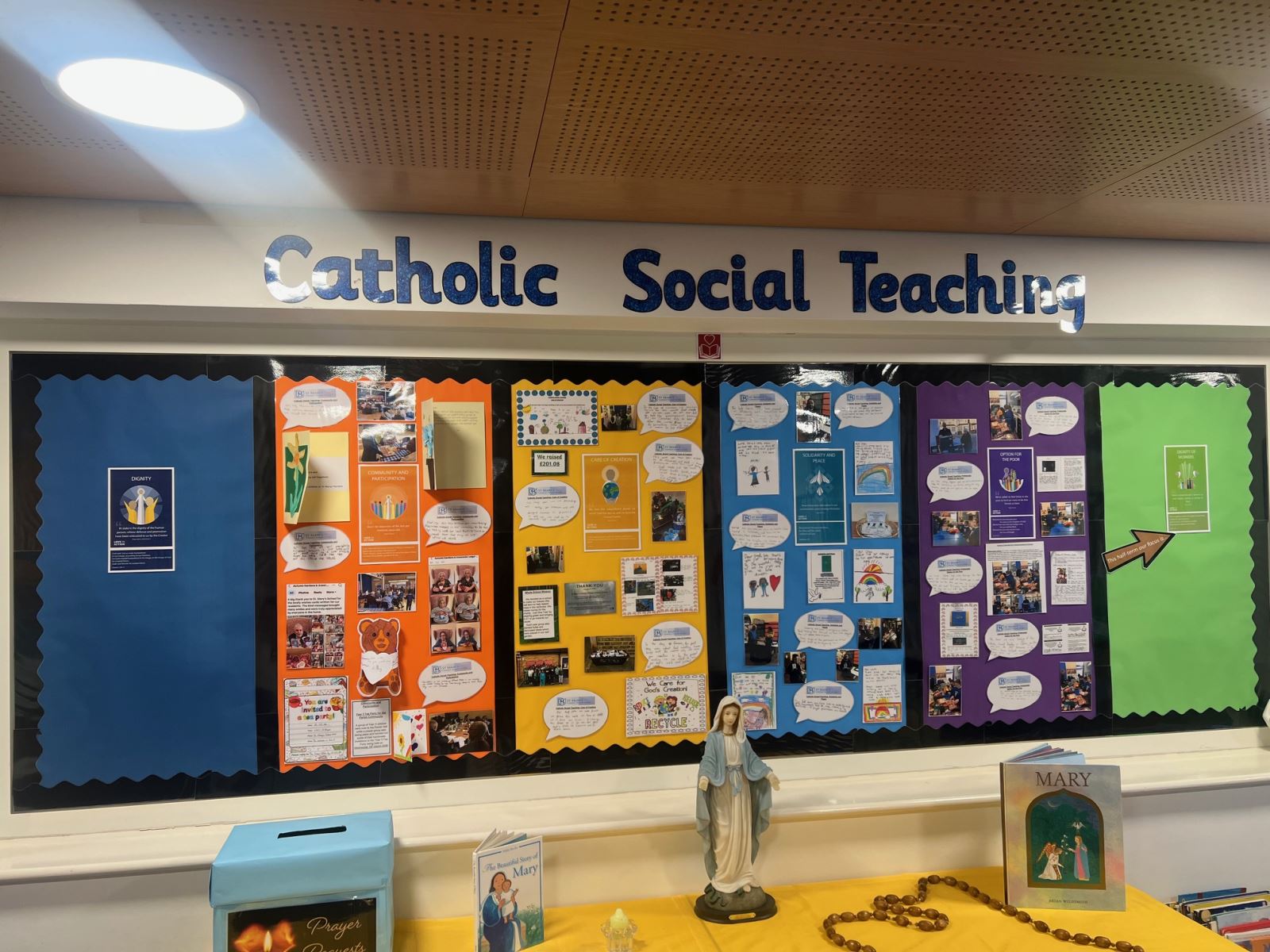
What is Catholic Social Teaching?
Catholic Social Teaching (CST) is based on a tradition of episcopal and papal writings on political, economic and social issues facing our time. CST provides us with a structure on how to encompass and apply these reflections to our daily lives. More importantly, it guides us on how we should respond to our faith as individuals, and actively respond to God’s call to work towards a common good.
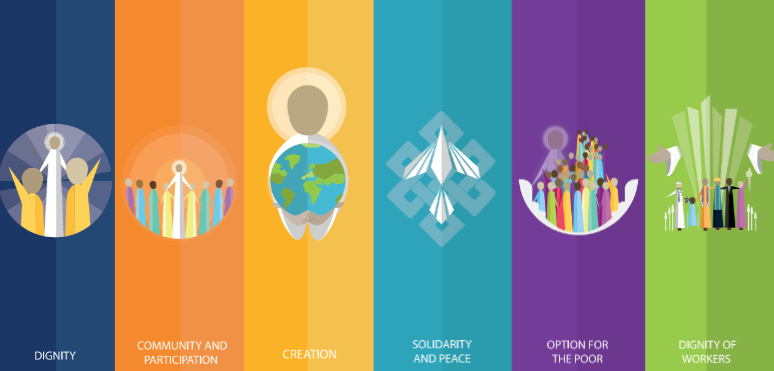
Principles of Catholic Social Teaching
An essential part of the Catholic faith, the key values of Catholic Social Teaching are found at the core of the Gospel. The key principles of CST are:

Dignity: Each of us is made in God’s image. Every person has an innate human dignity no one can take away. God said, ‘Let us make human-kind in our image, according to our likeness.’ Genesis 1:26
CLICK HERE TO SEE HOW WE MAP 'DIGNITY' ACROSS OUR CURRICULUM

Community & Participation: We live in community with others, growing together. We are called to be active participants in all that we do. We have a responsibility to be inclusive so that we allow all people to participate. “When each separate part works as it should, the whole body grows and builds itself up through love” Ephesians 4:16
CLICK HERE TO SEE HOW WE MAP 'COMMUNITY AND PARTICIPATION' ACROSS OUR CURRICULUM
Spring 2nd Half 2025 CST- Community and Participation
Whole school mission: As a school, we decided to remember our local community by every child designing and making a card for a resident in local nursing homes which have links with our parish and school. We discussed how as human beings we are inherently social, designed to thrive in connection with others rather than in isolation. The example of the early Church, call for active engagement in society to promote the common good, particularly for the poor and vulnerable and we wanted the people who received our cards to know that they are loved and valued.


Creation: Stewardship is all about caring for the many gifts that God has given to us. These include our environment, our own talents and other resources. All living things are connected so we must use God’s gifts responsibly to meet the needs of everyone, now and in the future. ‘The Lord God took the man and put him in the garden of Eden to till it and keep it.’ Genesis 2:15.
CLICK HERE TO SEE HOW WE MAP CARE FOR CREATION ACROSS OUR CURRICULUM
Autumn 1st Half 2025 CST-Care of Creation
Whole school mission: We decided as a school to make our mission to help replant trees in the rainforest. We raised money for the charity, 'One Tree Day.' Children and staff came into school wearing something green and donated a pound to go towards our cause. Each year group also planted bulbs and decorated labels which were placed in our school roof garden. Children understood that we were doing this as part of our duty to be stewards and the links from our Gospel Values.


Dignity of Workers: Catholic Social Teaching holds that work is dignified and an intrinsic good, and workers must always be respected and valued. The state has also the duty to protect the rights of all its people, and particularly of its weaker members, the workers, women and children. Work must be undertaken responsibly, and labour treated well, this includes how we approach the work we do, what it is we do with our work and how employers treat their employees. 'The hardworking farmer should be the first to receive a share of the crops. ' Timothy 2:6
CLICK HERE TO SEE HOW WE MAP DIGNITY OF WORKERS ACROSS OUR CURRICULUM
Summer 1st Half 2026 CST- Dignity of Workers
Whole school mission: As a school, we discussed the importance of everyone being treated fairly and that every worker, no matter their job should be given the same level of dignity as others. The school council worked very hard to help organize and promote our Fairtrade stall where children throughout the school donated Fairtrade items to be sold. We then donated all the profits earned to the Fairtrade Foundation.
Year 3 also made cards to show appreciation to members of our school community like our cleaners, lunch time staff, teaching assistants and office staff. This helped us to understand that it doesn’t matter the job which we do, we are all equal and important and should be treated with dignity.


Option for the Poor: A preferential option for the poor means that we think first about the needs of those who are the most vulnerable. Jesus taught that when we feed the hungry, welcome the stranger, clothe the naked, look after the sick and visit those imprisoned, we are looking after Him. ‘Learn to do good; seek justice, rescue the oppressed, defend the orphan, plead for the widow.’ Isaiah 1:17
CLICK HERE TO SEE HOW WE MAP PREFERENTIAL OPTION FOR THE POOR ACROSS OUR CURRICULUM
Autumn 2nd Half 2025 CST- Preferential Option for the Poor
Whole school mission: As a school, we decided to help our local food bank as a way of demonstrating the Gospel Value that Jesus taught us about putting those poorer people’s needs before our own. Each year group had a particular food item which they were collecting and we even made Christmas ornaments to be added to the parcels we made. This opportunity to help and care for those less fortunate than us, really helped us as a school to truly appreciate what it means to put others needs before our own especially those who most need our help.


Solidarity & Peace: Being in solidarity is recognising others as our brothers and sisters and actively working for their good. We are connected to people and places all over the world. 'All of you are one in Christ Jesus.’ Galatians 3:28. Peace is not just the absence of war. It is part of God’s nature, and a value we should all seek to live out in our daily lives. Peace comes from both justice and love and is dependent upon people understanding one another. ‘...those who promote peace have joy.’ Proverbs 12:20
CLICK HERE TO SEE HOW WE MAP SOLIDARITY AND PEACE ACROSS OUR CURRICULUM
Spring 1st Half Term 2026 CST- Solidarity and Peace
Whole school mission: As a school this half term, we decided to write prayers for peace. We discussed that peace is not merely the absence of war, but the result of justice, solidarity, and the active promotion of human dignity. We thought about creating our prayers for peace to help convert hearts from violence to dialogue, aiding the vulnerable, and transforming weapons into tools of harmony. These prayers were then given to members of our parish community.

Rooted in Love is a Religious Education resource for primary schools, developed in partnership with the Diocese of Westminster Education Service and funded by the ALF grant. It addresses the objectives relating to Catholic Social Teaching from the new Religious Education Directory, including prayer and liturgy ideas around each theme, as well as suggestions for bringing this work to life in the Catholic life and mission of the school. Rooted in Love is split into 6 themes, one for each half term. Each half-term we have a whole school focus on one of the six themes based on the Caritas 'Rooted in Love' Resource. This includes a whole school assembly and differentiated lessons for each class that help us deepen our understanding around each theme. Each year group then selects a mission which they will lead and carry out in line with the theme of that half term.
Please click here to find out more.
Here is a breakdown of our Catholic Social Teaching themes for each half term:
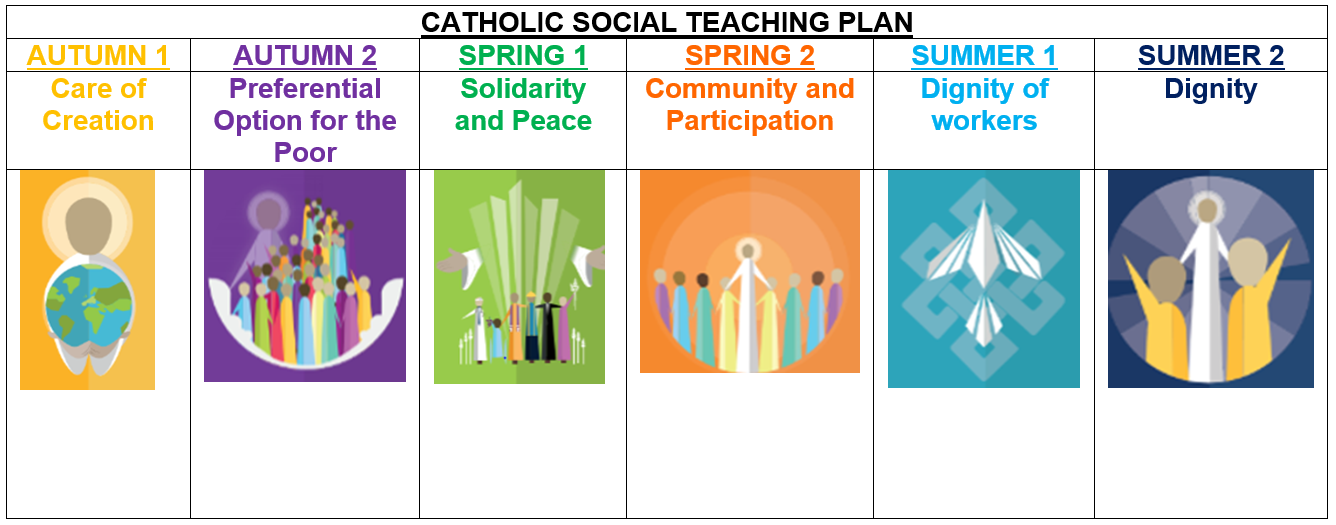
CATHOLIC SOcIaL TEACHING PLANNING OVERVIEW-ROOTED IN LOVE
wORLD BOOK DAY- lINKS TO CATHOLIC SOCIAL TEACHING
Click on the links below to see how we have broadly mapped the Catholic Social Teaching themes to our curriculum areas:
CROSS CURRICULAR CURRICULUM LINKS CARE FOR CREATION
CROSS CURRICULAR CURRICULUM LINKS COMMUNITY AND PARTICIPATION
CROSS CURRICULAR CURRICULUM LINKS DIGNITY OF WORKER
CROSS CURRICULAR CURRICULUM LINKS DIGNITY
CROSS CURRICULAR CURRICULUM LINKS PREFERENTIAL OPTION FOR THE POOR
CROSS CURRICULAR CURRICULUM LINKS SOLIDARITY AND PEACE
Click on the links below to see how we have more specifically mapped the Catholic Social Teaching themes to our Medium Term Planning for the Summer Term:
RECEPTION MEDIUM TERM PLANNING CATHOLIC SOCIAL TEACHING LINKS SUMMER TERM 2025-2026
YEAR 1 MEDIUM TERM PLANNING CATHOLIC SOCIAL TEACHING LINKS SUMMER TERM 2025-2026
YEAR 2 MEDIUM TERM PLANNING CATHOLIC SOCIAL TEACHING LINKS SUMMER TERM 2025-2026
YEAR 3 MEDIUM TERM PLANNING CATHOLIC SOCIAL TEACHING LINKS SUMMER TERM 2025-2026
YEAR 4 MEDIUM TERM PLANNING CATHOLIC SOCIAL TEACHING LINKS SUMMER TERM 2025-2026
YEAR 5 MEDIUM TERM PLANNING CATHOLIC SOCIAL TEACHING LINKS SUMMER TERM 2025-2026
YEAR 6 MEDIUM TERM PLANNING CATHOLIC SOCIAL TEACHING LINKS SUMMER TERM 2025-2026
Fundraising Activities and Opportunities
At St Mary’s Catholic Primary School, we recognise the importance of following the call of Jesus to live lives with a commitment to the greater good. Through being committed to works of charity, we are developing in children their understanding of the responsibility that has been placed upon us to do what we can to show our support of and solidarity with all members of God's family. Our commitment to the support of those less fortunate than ourselves leads us to support local, national and international organisations and charities in their work with those in need throughout the course of the academic year.
These include but are not limited to:
-
Harvest Festival
-
Little Hearts Matter
-
Just One Tree
-
The Nightingale Hospice
-
Manna Centre
-
CAFOD- Christmas in a box
-
Catholic Children Society- Lenten Appeal
-
Save the Children – Christmas Jumper Day
-
Marie Curie Cancer Care
-
Comic Relief
-
BBC Children in Need
-
Red Nose Day
-
NSPCC- Stop Cruelty to children
-
McMillan Coffee Afternoon
In addition to this as part of their Catholic Social Teaching missions, classes will periodically throughout the year carry out their own individual fundraising work for example collecting donations for local foodbanks etc.
The Lenten Gospels and Catholic Social Teaching 2026
This year we will be exploring how the Lenten Gospel reading can be linked with Catholic Social Teaching and exploring these with our children in class and during assemblies. Have a look at the table below which highlights the key points and links which will be made each week.
|
Gospel Reading
|
Scripture
|
Catholic Social Teaching Strand
|
Links to be made
|
|
Temptation in the Wilderness
|
Mark 1:12-15
|
Human Dignity and Solidarity
|
Jesus’ time in the wilderness, facing temptation, highlights His solidarity with humanity. He experiences hunger, vulnerability, and isolation, yet resists evil. This reflects the CST principles of human dignity- that every person, despite weakness or suffering, is made in God’s image and worthy of respect. The passage also stresses solidarity: Christ joins us in our struggles, calling us to support one another, especially those facing trials.
|
|
The Transfiguration
|
Mark 9:2-10
|
Community and Participation
|
At the Transfiguration, Jesus is revealed in glory before Peter, James and John. This moment is not experienced in isolation but shared in community. Catholic Social Teaching emphasises that we are made for community and called to participate in the life of society. Just as the disciples are invited to witness Christ’s glory, all are called to participate in God’s plan and society, affirming the value of each person’s voice and presence.
|
|
Cleansing of the Temple
|
John 2:13-25
|
Rights, Responsibilities and Justice
|
Jesus drives out the money changers, denouncing the exploitation of the vulnerable within the sacred space. This Gospel reflects the CST principle of rights and responsibilities- each person has a right to dignity and fair treatment, but also the responsibility to act justly. The passage challenges economic injustice and calls for structures that respect the rights of all, especially in places mean for worship and community.
|
|
“God So Loved the World…”
|
John 3:14-21
|
Option for the Poor and Human Dignity
|
Jesus speaks of God’s immense love for the world, offering salvation for all. This universal love is foundational to CST’s option for the poor and vulnerable. If God’s love is for everyone, then society must especially care for those who are marginalized or suffering. The dignity of every person is affirmed by God’s willingness to give His Son for our salvation.
|
|
“Unless a Grain of Wheat Falls…”
|
John 12:20-33
|
Sacrifice, Solidarity and the Common Good
|
Jesus teaches that true life comes through self-giving and sacrifice. Catholic Social Teaching echoes this in its call to promote the common good. Individual sacrifice for the benefit of others, especially the vulnerable, is at the heart of both the Gospel and CST’s vision of solidarity- a commitment to the good of all, not just oneself.
|
|
The Passion
|
Mark 14:1-15:47
|
Dignity, Suffering and Justice
|
The Passion narrative, recounting Christ’s suffering and death, is a profound meditation on human dignity in the face of injustice. Jesus, though innocent, endures humiliation and violence. His response- marked by forgiveness and love- calls Christians to stand with those who suffer injustice today and to work for a society where dignity is protected, and justice prevails.
|